

Flipped Classrooms: A Strategic Approach to Teacher Burnout
In recent years, teacher burnout has become a pressing concern in education. The demands of teaching can be overwhelming, and many educators struggle to maintain their energy and enthusiasm for the profession. One effective strategy that can help alleviate teacher burnout is the flipped classroom model. This article will explore the benefits of flipped classrooms, provide practical tips for implementation, and discuss how this approach can lead to increased student engagement and reduced teacher stress.
Defining Flipped Classrooms
Flipped classrooms are often misunderstood as simply "putting lectures online." However, this oversimplifies the concept. A flipped classroom is a pedagogical approach that aims to optimize learning by reversing the traditional lecture-homework format. By doing so, teachers can create a more engaging and interactive learning environment.
In essence, flipped classrooms involve delivering instructional content outside of class time, allowing students to access it at their own pace. This can include video lectures, online tutorials, readings, or other forms of digital media. The classroom then becomes a space for more dynamic and hands-on activities, such as discussions, group work, and experiments.
By flipping the traditional lecture-homework format, teachers can create a more student-centered learning environment. This approach encourages students to take ownership of their learning, exploring concepts in-depth and developing critical thinking skills through inquiry-based activities.
The Flipped Classroom Model: What is it?
A flipped classroom is an instructional strategy that reverses the traditional lecture-homework format. Instead of delivering lectures in the classroom, teachers create video or online content that students watch at home. This frees up class time for more interactive and engaging activities, such as discussions, group work, and hands-on experiments.
This approach can be particularly effective in high schools, where students often need guidance on how to navigate the complexities of adolescence. By providing students with a more personalized learning experience, teachers can tailor instruction to meet individual needs and abilities.
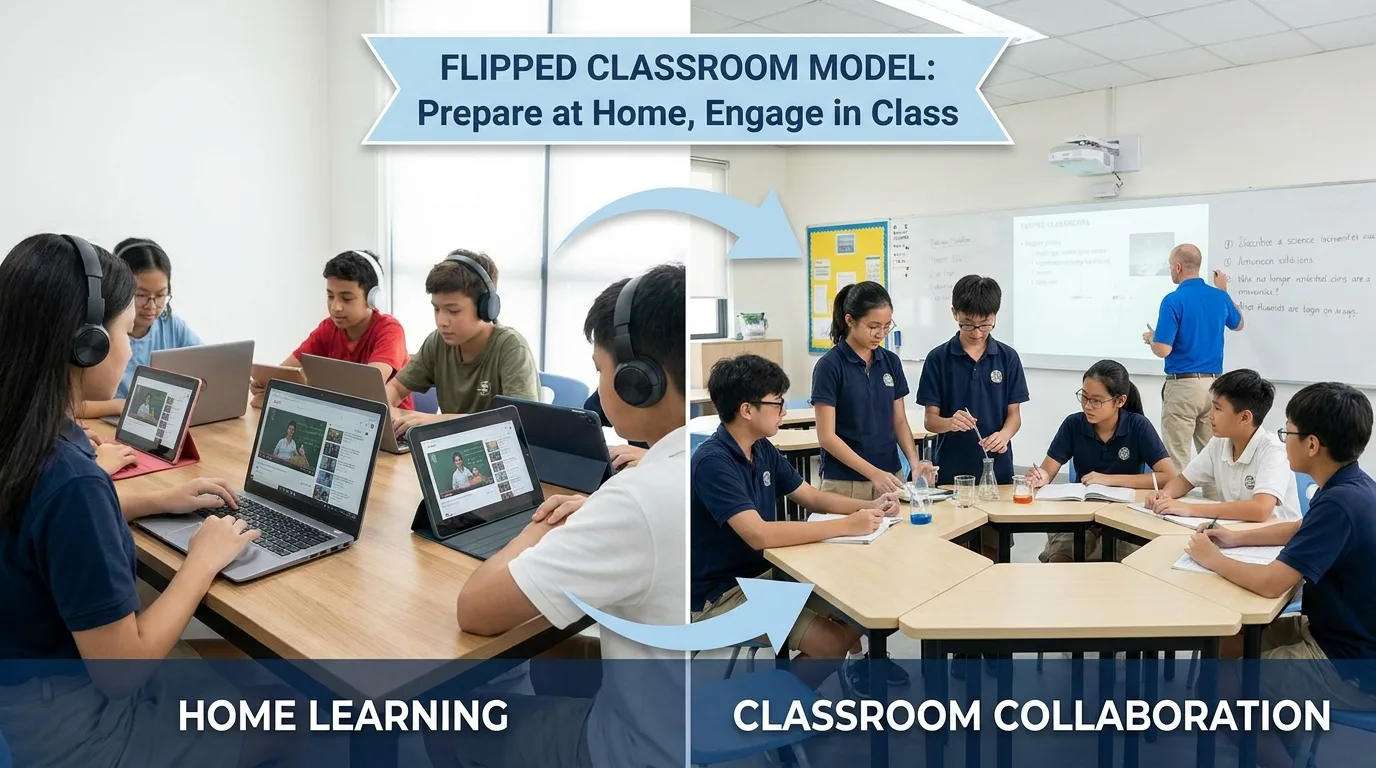
Benefits of Flipped Classrooms
Research has shown that flipped classrooms can have numerous benefits for both teachers and students (Koehler & Mishra, 2008). Some key advantages include:
• Increased student engagement: By providing students with a more interactive learning experience, flipped classrooms can lead to increased student participation and motivation.
For example, when students are engaged in hands-on activities, they are more likely to retain information and develop critical thinking skills. This is particularly important in subjects like science, technology, engineering, and mathematics (STEM), where hands-on experimentation is essential for learning.
• Improved teacher-student relationships: Flipped classrooms allow teachers to build stronger relationships with their students by having more time for individualized instruction and feedback.
This is particularly important in high schools, where students often need guidance on how to navigate the complexities of adolescence. By providing students with a more personalized learning experience, teachers can tailor instruction to meet individual needs and abilities.
• Enhanced academic performance: Studies have shown that students who participate in flipped classroom models tend to perform better academically than those who do not (Renzulli, 2010).
By providing students with a more interactive and engaging learning environment, teachers can create conditions for deeper learning. This approach encourages students to explore concepts in-depth, developing critical thinking skills through inquiry-based activities.
Implementing a Flipped Classroom: Practical Tips
While the benefits of flipped classrooms are clear, implementing this model can be a daunting task. Here are some practical tips to help you get started:
Step-by-Step Implementation
1. Start small: Begin by flipping one or two lessons per week, gradually increasing the number of classes as you become more comfortable with the approach.
This will allow you to refine your instructional design and assess student progress before scaling up. By starting small, you can test your implementation plan and make necessary adjustments along the way.
2. Choose the right tools: Select technology that is user-friendly and easily accessible for both teachers and students.
When selecting digital tools for flipped classrooms, consider the needs of both teachers and students. Ensure that the chosen platform or tool is intuitive, allowing teachers to create high-quality content with ease. Additionally, select a tool that is compatible with various devices, making it easy for students to access learning materials on-the-go.
3. Involve students in the process: Encourage students to take ownership of their learning by giving them a say in what activities they participate in.
This approach allows students to become more invested in their own education, leading to increased motivation and engagement. By involving students in the design of lesson plans, teachers can tailor instruction to meet individual needs and abilities.
Final Thoughts
When implementing flipped classrooms, it's essential to remember that this is a pedagogical approach, not simply a technology-driven strategy. By focusing on instructional design, teacher-student relationships, and student engagement, educators can unlock the full potential of flipped classrooms and create transformative learning experiences for their students.
To create an effective flipped classroom model, teachers must consider the needs of both themselves and their students. This involves developing a clear understanding of the subject matter, as well as creating engaging lesson plans that cater to diverse learning styles.
By adopting this approach, educators can create conditions for deeper learning, leading to improved academic performance, increased student engagement, and reduced teacher burnout.
References:
Koehler, M., & Mishra, P. (2008). In Search of Digital Literacy: An Exploratory Study Among Preservice Teachers.
Renzulli, J. S. (2010). The Three-Ring Conception of Giftedness: A Developmental Model for Creative Production.
Note to self:
Consider the needs of both teachers and students when implementing a flipped classroom model.
Involve students in the design of lesson plans to increase motivation and engagement.
Focus on instructional design, teacher-student relationships, and student engagement to unlock the full potential of flipped classrooms.
This Article was made with AI assistance and human editing.